
Grand Harbor Audubon
Garden Bingo
Audubon has a wonderful new activity for children to use while exploring our garden. Just stop by and ask the GH concierge for a Garden Bingo card for each child and enjoy this activity with your children and/or grandchildren. When done, the child can stop by the concierge for a treat.
If you are interested in seeing our winter 2025 bingo card, please click here.
The card will be updated seasonally to highlight specific plants in bloom or different flora. Have fun!
Seen in Grand Harbor


Click on any photo for Full Screen
We encourage Audubon and Club members to email info@grandharboraudubon.org to share pictures of birds, plants and wildlife captured in Grand Harbor.
All residents are welcome to join GHA. We look forward to receiving your photos!
Thank you to all that submitted the beautiful pictures.

***************************************************
The January Worker Bee is being held on January 5th from 10-12
Any amount of time that you can volunteer is greatly appreciated!
***************************************************

Did You Know?
“A group of white pelicans, known for being social, has several colorful collective nouns, most commonly a pod, scoop, squadron, brief, pouch, or fleet, with "pod" and "squadron" being very popular for their large gatherings in the air or on water.
Here are the various terms:
-
Pod: A very common term for pelicans, especially when gathered together.
-
Scoop: A popular name, possibly related to their feeding method.
-
Squadron: Often used for large groups flying together, highlighting their coordinated flight.
-
Brief: Another widely used term, though its origin might be linked to the movie The Pelican Brief.
-
Pouch: A less common but recognized term for their gatherings.
-
Fleet: Sometimes used, especially when they are fishing cooperatively in a large group”.
(Information from Google AI Overview)
Honking in the Holidays: December with the Egyptian Geese
Article Courtesy of Janet Thomas

The Egyptian Goose: A Global Intruder with Enduring Appeal
The Egyptian Goose is often described as a “riddle wrapped in a mystery inside an enigma.” This robust and exotic bird is steadily winning the affection of Grand Harbor residents, even though it is clearly a non-native species. Even those who are less enthusiastic find themselves admiring its resilience, boldness, and colorful plumage.
Historical and Cultural Significance
Egyptian Geese made a lasting impression in ancient Egyptian culture. Historians are uncertain about the reasons, but these birds were considered sacred. Many were kept in private aviaries and even buried alongside their owners. Images of the Egyptian Goose are found on pyramid walls and gravesites, highlighting its prominent role in ancient Egypt.
Global Expansion
The first Egyptian Geese to leave the Nile valley and sub-Saharan Africa traveled as caged trophies on explorers’ ships to England. Coveted for their unique appearance and energy, they were displayed in museums and mansions. Some escaped and established nests, leading to colonies that multiplied. By the 1870s, feral populations appeared in East Anglia and soon spread to the Netherlands and northern Germany. Northern populations migrate in late autumn in search of unfrozen ponds and bays. Today, Egyptian Geese are found in more than 50 countries outside Africa. Thriving colonies in Florida, Texas, and California trace their origins to immigrants from the Caribbean, with hurricanes in 2004 and 2005 helping small flocks disperse. In Florida and other warm climates, Egyptian Geese are year-round residents.
Feeding and Identification
Unlike most ducks, Egyptian Geese do not feed in the water. They graze on land near ponds, eating seeds, grasses, leaves, and other vegetation. Males and females look similar, with females being slightly smaller and juveniles having paler plumage. Their upper feathers range from reddish to grey-brown, with lighter shades on the flanks and undersides. A chocolate patch marks the breast, and the wings feature black outer feathers with shiny green sections. The eye-ring varies from orange to black, and legs and feet are pink, turning redder during breeding.
Flight, Nesting, and Vocalization
Egyptian Geese are somewhat clumsy in flight and resemble ducks except for their heavier builds. Their flocks do not form aerodynamic “V” shapes in the sky. It’s common to see a large Egyptian Goose perched on a tree limb or building corner. They mate for life and can live 15 years or longer in the wild. Most breeding occurs in spring, with nests typically found in large tree cavities. Breeding is fiercely territorial, often resulting in mid-air conflicts. Males are generally quieter but will issue hoarse alarm calls when threatened. Females are noisier, with frequent and persistent quacks, especially when protecting their young.
Physical Characteristics and Behavior
Egyptian Geese are easy to spot on golf courses, often near small lakes bordered by grassy meadows. Egyptian Geese are easily recognized by their distinctive markings and charismatic posture. Their upright stance and alert gaze often capture the attention of birdwatchers and casual observers alike. Adaptable and resourceful, these birds have learned to thrive in a variety of habitats, from manicured lawns to urban parklands, further demonstrating their remarkable versatility.
Their presence prompts questions like, “What is that bird I saw? Sort of a mallard with dark glasses… loud… big white patch when it flies?” Their aggressive territorial habits deter Canada Geese, which many golfers and park-goers appreciate. Measuring up to 29 inches in length with a wingspan of 58 inches, these birds are hard to miss. They live harmoniously with smaller ducks and sometimes hybridize with mallards. In fact, one of our resident couples have adopted “UNCLE MANKY,” a hybrid of an Egyptian Goose with a Mallard duck. "Manky" (British slang) implies something dirty, mixed, or a bit off, fitting these often strange-looking ducks with varied plumage, and describing the patchwork look of these birds. This alternative family has been in residence at Grand Harbor for more than 4 years!


The Family Over the Years

Uncle "Mankie" - photo courtesy of H. Rivero
Update on the Family
Mid-Late December
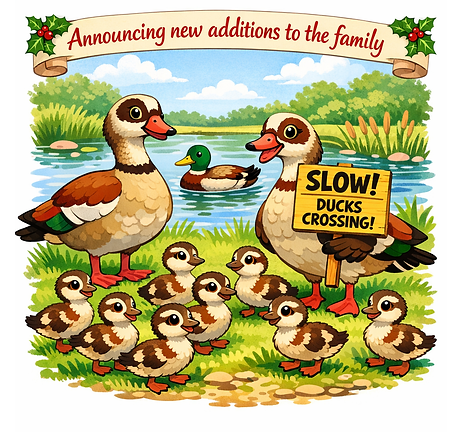
Photo generated by J. Thomas
We are delighted to welcome our new ducklings to the GH Egyptian geese family! As these little ones begin exploring their surroundings, let’s all take extra care to protect them.
Please remember to drive slowly and cautiously on our roads, especially since we recently experienced the tragic loss of one of our beloved geese. Your attentiveness helps keep our feathered family safe and thriving. Please reach out to GH Audubon if you witness ANY injured wildlife on our properties.
Janet Thomas


December Newsletter Update
Egyptian Geese Ducklings Video
Courtesy of J. Thomas
Double click to open the video to full screen
Dolphins Educational Presentation
Grand Harbor Audubon (GHA) hosted a presentation on dolphins on December 1st at the main GH clubhouse. GHA president, Lyn Groves introduced Mr. Steve Burton of the Harbor Branch Oceanographic Institute, spoke of her connection to it as well as provided information on the Institute. To read Lyn's introduction, click here.
Mr. Burton provided the audience with an overview of what he and his team do at Florida Atlantic University (FAU). Mr. Burton is the Director of the Stranding and Population Assessment team at FAU Harbor Branch. He has worked at FAU since April 2010, and his team responds to marine mammal strandings and performs monthly boat-based photo identification surveys in the Indian River Lagoon and Atlantic Ocean between Sebastian and Jupiter Inlets.
The audience was very engaged in the presentation with a question-and-answer session that lasted well over 15 minutes. Several of his slides along with some photos of GHA leaders and attendees are below.


A Surprise Encounter
The two Northern Gannets lay on the sand, so still. I came across the juveniles while walking on the beach recently. These two very large seabirds, larger than gulls but a bit smaller than Brown Pelicans, did not appear stressed or injured. I spoke with another beach wanderer who told me she had called the FWC hotline and was told they were probably just resting from a long flight, not to worry. But still, I wondered what these youngsters were doing in Florida so far from their probable birthplace in Canada and were they really healthy?
The two Northern Gannets were just 3 to 6 months old, having fledged in September or October from one of six main nesting sites in Canada. The largest site being on the rocky cliffs of Bonaventure Island where some 100,000 Gannets nest. After about three months in the nest being fed by mom and dad, our two chicks (not siblings) stand at the edge of the cliff looking down at a 100 to 200 foot vertical drop, and fly for the first time to the sea. With no practice or strong wing muscles, their first flight is more like a glide. From here there is much learning for our young ones, not only how to fly but also how to fish. Their first year of life is harrowing as they travel south alone, migrating to the warm waters of Florida, The Gulf of Mexico, or the Caribbean Sea honing their skills, much farther than adult Gannets travel. The juvenile Northern Gannets will continue exploring and wandering until the age of three or four when they will head back north in the summer to check out possible nesting sites for when they reach adulthood at five or six.
Fun facts about Northern Gannets
-
It is more common in Florida to see juveniles than adults. Look for them at the Sebastian Inlet or the Fort Pierce Inlet.
-
Adults are snow white with buff-yellow on their head and neck and icy blue eyes, a stunningly beautiful seabird.
-
Gannets are plunge divers. From a height of 33 to 100 feet above water, they hit the water at 50mph, which makes them twice as fast as Brown Pelicans and 20 mph faster than Boobies.
-
These seabirds are pelagic, meaning they only come to land to breed.
FWC Hotline 888-404-3922
PS - I went back to the beach the next day to check on the two Northern Gannet
seabirds and was delighted to see that they were gone ! Happy holiday to our Gannets
and to all of you. Lyn Groves


A Wing and a Prayer
One Sunday afternoon in December, Pene Chambers, a Saint David’s resident, found a bird, an Anhinga, with an injured wing. Pene was extremely concerned that that the bird would be easy prey for nighttime predators. She called Alex Diedrick, a neighbor and Audubon board member. The Anhinga needed to be rescued promptly. Alex met Pene with a cage.
Capturing a wounded Anhinga is not as easy as it sounds. Alex called Indian River Animal Control (the phone number is on the GH Audubon Resources webpage). It was on Sunday; however, the message said press 2 if you have found an injured animal. Alex pressed 2 and was connected to the IRC Sherriff’s Department.
The Sheriff’s Office was great! They promptly dispatched an Animal Control Officer. Meanwhile Pene and Alex watched over the Anhinga who walked around seeking safety. Another Saint David's resident and GH Audubon member, Bob Filebark, heard from his wife what happened so he joined them with a pair of heavy duty work gloves to assist as needed. After some attempts to capture the bird, IRC Animal Control Officer Bohannon arrived on the scene. As seen in the photos, Officer Bohannon rescued the Anhinga and we are all so grateful to her and to the Sheriff’s Department for so promptly answering our call for help. ~ Alex Diedrick


Click to visit our Resources Page
For Answers to Common Questions about Injured Birds or Wildlife
Grand Harbor Audubon
Butterfly & Native
Nature Gardens
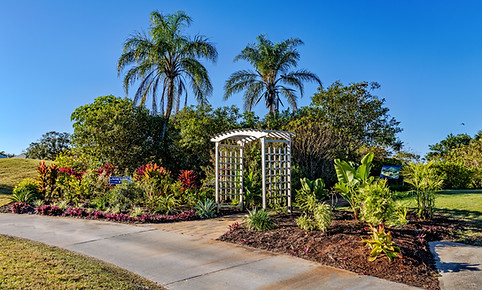
There is a place in Grand Harbor where birds and butterflies abound. The Nature Gardens are are alive with plants, trees, birds and butterflies in a thriving natural scene.
The Nature Gardens are located behind the main GH clubhouse, on the other side of any of the bridges. Follow any one of the paths behind the clubhouse toward the big pond (aqua range) and look for a pergola which is the entrance to the gardens. We welcome both Grand Harbor club members and community residents to explore and enjoy the gardens. Take a walk on the wild side and visit our Nature Gardens. We would also love to have you join one of our worker bees!
In order to maintain the gardens, monthly "worker bees" are held during the season and in the summer where volunteers show up at their own convenience to pitch in with planting, weeding, mulching, trimming, etc., whatever is needed at the time.
Tribute Pavers
Our program of selling tribute pavers in the Audubon Gardens has been warmly received by the Grand Harbor community. To date, more than 60 pavers have been engraved to thank friends, honor loved ones and celebrate milestone events. All proceeds are dedicated to improving and maintaining the gardens.

Our paver program continued this Fall. Order forms can be picked up at the concierge desk at the Club or downloaded from our website and dropped off at the concierge desk. Order forms are also available at our programs.
Click below the PDF to open
More ... Seen in Grand Harbor Through the Years


